
EZContact vs Intercom: The Better Choice for WhatsApp Customer Service (2026)
Comparing EZContact and Intercom for WhatsApp customer service? This honest breakdown covers AI capabilities, WhatsApp-native support, setup complexity, pricing, and human handoff — so your team makes the right call.
If you need to serve customers on WhatsApp, Intercom is not your best option — and this article explains exactly why.
Intercom is a powerful customer communication platform built for SaaS companies managing support across web chat, email, and in-app messaging. EZContact is a WhatsApp-native AI messaging platform built for businesses where WhatsApp, Instagram, and Facebook Messenger are the primary customer channels.
That distinction — web-first vs. WhatsApp-first — determines everything: which tool fits your customers, which fits your team, and which you’ll be debugging at 9 PM six months from now.
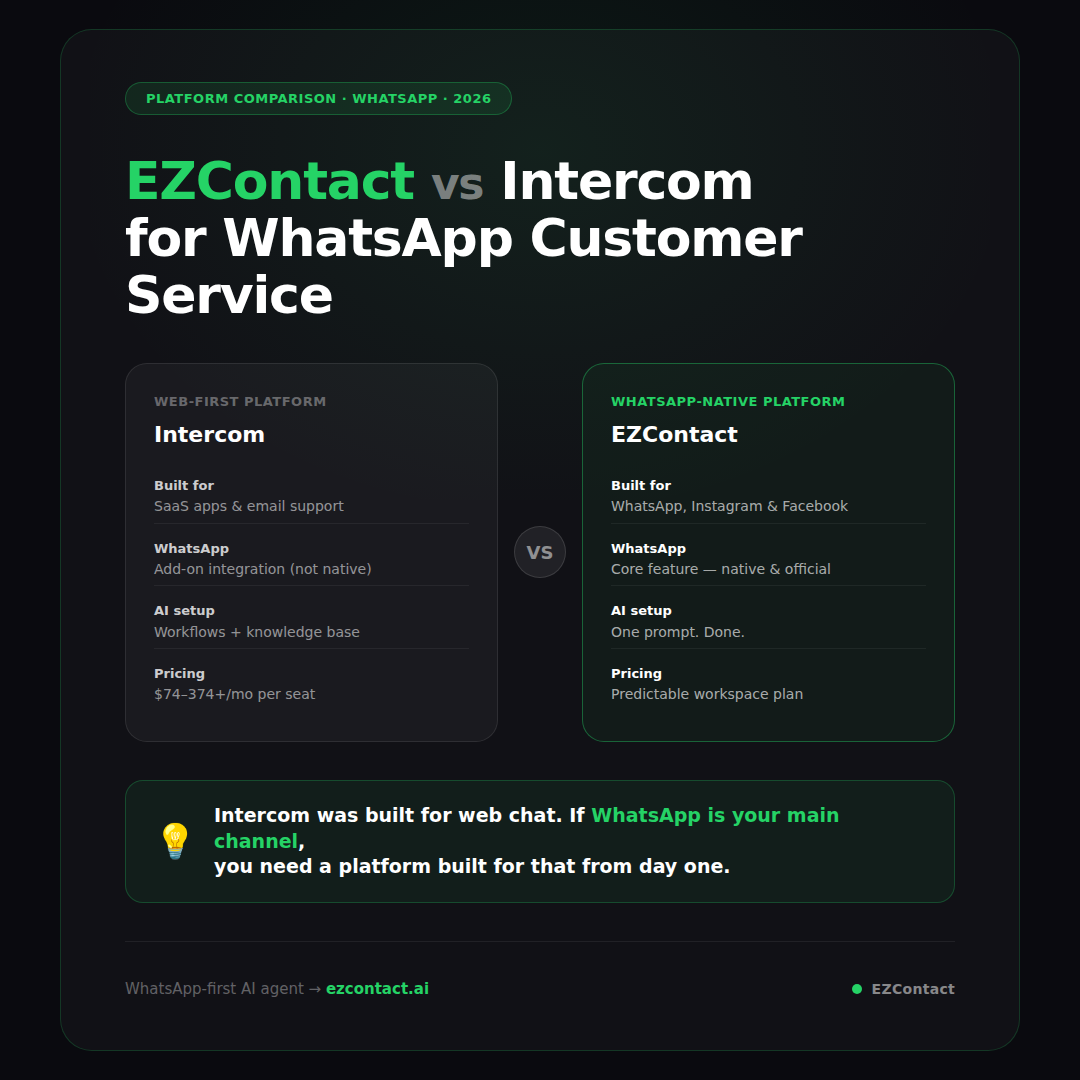
Quick Comparison
| Intercom | EZContact | |
|---|---|---|
| Built for | Web/app/email support (SaaS-first) | WhatsApp + social messaging (SMB-first) |
| WhatsApp support | Add-on integration (not native) | Native, core product feature |
| Channels | Web chat, email, SMS, WhatsApp (add-on) | WhatsApp, Instagram, Facebook (unified) |
| AI agent | Fin (GPT-4 powered, ticketing-focused) | AI agent per channel, conversational + handoff |
| AI configuration | Knowledge base + workflow builder | Single text prompt — no flows |
| Human handoff | Ticket-based, configurable routing | Native real-time handoff, unified inbox |
| Dynamic data | Static articles / knowledge base | Data Tables — AI queries live data |
| Contextual files | Not automated | Context-triggered file sending |
| WhatsApp onboarding | Via third-party integration | Embedded Signup inside the platform |
| Pricing | $74–374+/month per seat, enterprise contracts | Workspace-based, predictable monthly |
| Best for | SaaS support teams with complex ticketing needs | SMBs wanting real WhatsApp AI + team inbox |
| Setup time | Days to weeks (complex configuration) | Hours (one prompt, done) |
What Intercom Does Well
Intercom has spent over a decade building one of the most capable customer communication platforms for SaaS and enterprise companies. If your product is a web or mobile app and your support team handles thousands of tickets across email, in-app chat, and help center content, Intercom is hard to beat.
Its Fin AI agent is genuinely impressive for SaaS support workflows. Fin can answer customer questions using your help center content, resolve tickets autonomously, route conversations based on intent, and escalate to human agents when needed. For companies whose primary support surface is a web app or website, Fin dramatically reduces support volume.
Its ticketing and workflow tools are enterprise-grade: SLA tracking, CSAT surveys, ticket assignment rules, detailed reporting, and integration with tools like Salesforce, Jira, and Slack.
Intercom wins when:
- Your product is a SaaS app or website and support happens primarily in-app or by email
- You have a large support team with complex ticket routing, SLAs, and escalation needs
- Your customer communication is documentation-heavy (help center articles, product tours, in-app tooltips)
- You have budget for an enterprise-level platform and technical resources to configure it
Where Intercom Falls Short for WhatsApp Businesses
Intercom was designed for web-app and email support. WhatsApp is an integration that was added later — and that origin shows in several ways that matter day-to-day.
WhatsApp is not a first-class channel in Intercom. To connect WhatsApp, you need a separate BSP (Business Solution Provider) account and a third-party integration layer. The setup is more complex than simply turning on a toggle, and when WhatsApp behaves differently from web chat — which it often does — support is split between Intercom and your BSP.
Fin wasn’t designed for conversational WhatsApp. Fin is optimized for resolving support tickets using help center documentation. WhatsApp conversations in LATAM and SMB contexts are often sales inquiries, appointment requests, quote follow-ups, and lead qualification — not documentation-answerable support tickets. Fin’s strengths don’t map onto these workflows well.
Intercom doesn’t include Instagram or Facebook Messenger natively. If your customers also reach you on Instagram or Facebook — common for retail, services, and LATAM businesses — you’re managing separate tools or additional integrations for each channel.
Pricing is enterprise-calibrated. Intercom’s plans start at $74/month and scale quickly based on seat count and usage, with WhatsApp add-on costs on top. For SMBs handling WhatsApp as their primary channel, the cost-to-value ratio rarely makes sense. You’re paying for enterprise ticketing features you won’t use and not getting the WhatsApp-native experience you actually need.
Setup complexity is high. Intercom’s power comes with configuration complexity. Setting up Fin, building workflows, connecting WhatsApp, and onboarding your team typically takes days to weeks and often requires a dedicated implementation period.
How EZContact Is Built Differently
EZContact starts from the premise that for millions of businesses — especially in LATAM — WhatsApp is the primary customer service and sales channel, not a secondary integration.
As an official Meta Business Partner, EZContact handles the full WhatsApp infrastructure: API access, webhooks, message template management, and phone number onboarding via Meta’s Embedded Signup directly inside the platform. No third-party BSP account required, no external configuration.
The AI configuration model is built for operators, not engineers. Instead of workflows and knowledge base imports, you write one prompt describing your agent:
“You are Sofia, customer service agent for Ferretería El Clavo. Answer questions about our tools, hardware, and supplies using the product catalog in Datos. Help customers confirm pricing and availability. When a customer wants to place a large order or needs a quote, hand off to a human agent.”
That’s the entire setup. The AI handles free-form messages from real customers — the kind of messages that don’t follow a script — identifies what each customer actually needs, and routes to a human when it makes sense.
And when your product catalog changes? You update the Datos table. The AI uses it immediately, without touching the prompt.
The Differentiators That Matter
1. WhatsApp-Native vs. WhatsApp as an Add-On
This is the foundational difference.
Intercom was built for web chat. WhatsApp was added as an integration — meaning the core product, the AI, and the team inbox were designed for a different communication model. WhatsApp customers behave differently: they send informal messages, use voice notes, expect fast replies, and have no patience for “please check our help center” responses.
EZContact was built for this from day one. The AI agent, the team inbox, the handoff logic, and the template management are all designed for how WhatsApp conversations actually work. That alignment matters when your team handles 100+ WhatsApp conversations per day.
2. Unified Inbox Across WhatsApp, Instagram, and Facebook
EZContact consolidates WhatsApp, Instagram DMs, and Facebook Messenger in a single inbox. Your AI agent handles all three channels. Your team sees all conversations in one place, regardless of where the customer reached out.
Intercom handles web chat, email, and SMS natively. Adding WhatsApp requires a BSP integration; Instagram and Facebook require additional configuration or separate tools. As a result, teams using Intercom for WhatsApp typically end up managing multiple inboxes — which defeats the purpose of having a unified platform.
3. Real-Time Human Handoff
EZContact’s handoff model is designed for WhatsApp’s conversational pace.
When the AI agent determines a conversation needs a human — the customer asked for one, the inquiry is complex, or the agent detects a buying signal — it flags the conversation in the team inbox, routes it to the right agent with full context, and keeps the customer in the same WhatsApp thread. Nothing changes for the customer. The agent steps in with the complete conversation history.
This isn’t a ticket. It’s a live conversation that moves seamlessly between AI and human. In Intercom, this flow requires careful workflow configuration and works best for asynchronous support — not the real-time, messaging-native experience WhatsApp customers expect.
4. Dynamic Data Without a Knowledge Base Import
Intercom’s Fin uses your help center articles and documentation as its knowledge base. When information changes, you update the article. When your product catalog is large or changes frequently, maintaining accurate documentation is an ongoing operational burden.
EZContact’s Data Tables (Datos) are structured tables — like Airtable — that the AI queries in real time during each conversation:
- A retailer updates inventory and pricing in a Datos table. Customers get accurate answers about product availability without a knowledge article being out of date.
- A recruiting agency activates or deactivates job openings. The AI immediately knows which positions are open.
- A services company manages appointment slots in Datos. The AI answers availability questions with current data.
The difference: Intercom’s AI answers from static documentation. EZContact’s AI queries live data your team manages.
5. Contextual File Sharing
EZContact AI agents can automatically send files — product catalogs, PDFs, price sheets, maps, appointment instructions — at the contextually right moment in a conversation.
A clinic can have the AI send pre-appointment preparation instructions when a patient confirms. A car dealer can have the AI send a vehicle brochure when a prospect asks about a specific model. You upload the file once, describe when to share it, and the AI handles the rest.
This is a meaningful capability gap: in Intercom, file sharing is either part of a configured message template or manually triggered by a human agent.
Real Business Scenario: LATAM Services Business
Consider a dental clinic in Mexico City receiving 300 WhatsApp messages per week: appointment requests, pricing questions, insurance inquiries, and follow-ups.
With Intercom, they’d need to set up a BSP integration for WhatsApp, build Fin workflows around their help center content, train agents on a platform built for SaaS ticket queues, and pay for enterprise features that don’t fit their operation. The cost alone — at $74–$200/month minimum plus WhatsApp add-ons — makes it a difficult fit for an SMB.
With EZContact, they write one prompt: the AI handles appointment scheduling by checking Datos for availability, answers pricing questions from the rates table, and routes to a human receptionist for insurance questions or when a patient needs to confirm a complex treatment plan. The whole team sees everything in one inbox. The AI handles 80–90% of messages autonomously. Monthly cost is a fraction of Intercom’s.
The right tool is the one built for how your customers actually reach you.
Pricing: What You Actually Pay
Intercom is enterprise-priced:
- Starter: ~$74/month (limited seats, basic features)
- Pro: ~$374/month (full suite, per-seat pricing)
- Enterprise: Custom pricing
- Plus additional costs for WhatsApp integration (BSP fees, per-conversation charges)
Intercom’s value proposition is strong for SaaS companies with 20–100+ seat support teams and complex ticketing requirements. For businesses where WhatsApp is the primary channel and the team is 2–15 people, the economics rarely make sense.
EZContact offers a workspace-based monthly model designed for SMBs — no per-conversation pricing surprises on top, no BSP fees layered onto your bill. For LATAM businesses, pricing is structured accordingly.
See current plans at ezcontact.ai →
When You Should Choose Intercom
Intercom is the right call when:
- Your primary product is a SaaS app or website, and most support happens in-app or by email
- You have a large support team (20+ agents) with complex SLA and ticket routing requirements
- Your support is documentation-heavy — resolving questions from a deep help center knowledge base
- You have the budget and technical resources to configure and maintain an enterprise platform
- WhatsApp is a small secondary channel, not your primary customer communication surface
When EZContact Is the Right Answer
EZContact is the better choice if:
- WhatsApp is your primary customer channel — for sales, support, appointments, or lead qualification
- You also receive messages on Instagram or Facebook and want them in one inbox
- You want a real AI agent that understands natural language, not a chatbot trained on documentation
- Your team is 2–20 people who need a tool they can learn in a day, not a week
- Your business information changes often — inventory, availability, pricing, job openings
- You want AI and human agents to work together in the same inbox, without separate ticket queues
- Predictable monthly pricing matters more than enterprise-scale features you won’t use
One Platform. WhatsApp-First. AI + Human, Together.
Intercom is a great product for the problem it was built to solve: SaaS customer support across web and email channels. If that’s your situation, it delivers.
But if your customers are reaching you on WhatsApp — and increasingly on Instagram and Facebook — you need a platform built for that reality, not one that added WhatsApp as an afterthought.
EZContact is built for WhatsApp from the ground up. One prompt to configure your AI agent. Live data your team controls. Seamless handoff between AI and humans. A single inbox for every channel.
Start your free trial at ezcontact.ai →
Or message us on WhatsApp and we’ll walk you through the platform with your specific use case.
Related articles
Aug 2026
EZContact vs Yalo: Best WhatsApp AI Platform for LATAM?
Compare EZContact vs Yalo for WhatsApp AI, conversational commerce, human handoff, implementation, and the right business fit in LATAM.
Aug 2026
EZContact vs Salesforce Service Cloud: WhatsApp Service Without Enterprise Complexity
Comparing Salesforce Service Cloud and EZContact for WhatsApp customer service? See the honest 2026 breakdown of AI, handoff, setup, pricing, and fit.
Aug 2026
WhatsApp Voice AI: Handle Calls, Voicemails & Customer Service with an AI Agent
WhatsApp Voice AI combines a 24/7 AI phone agent with WhatsApp follow-up, call summaries, appointment booking, and human handoff. See how the workflow works.
Put your WhatsApp to work with EZContact
An AI agent that knows your business, a unified inbox, and human handoff when needed. No complex flows — set it up with a single prompt.